
Why Your Phone Isn’t Charging: Common Causes and Repair Solutions
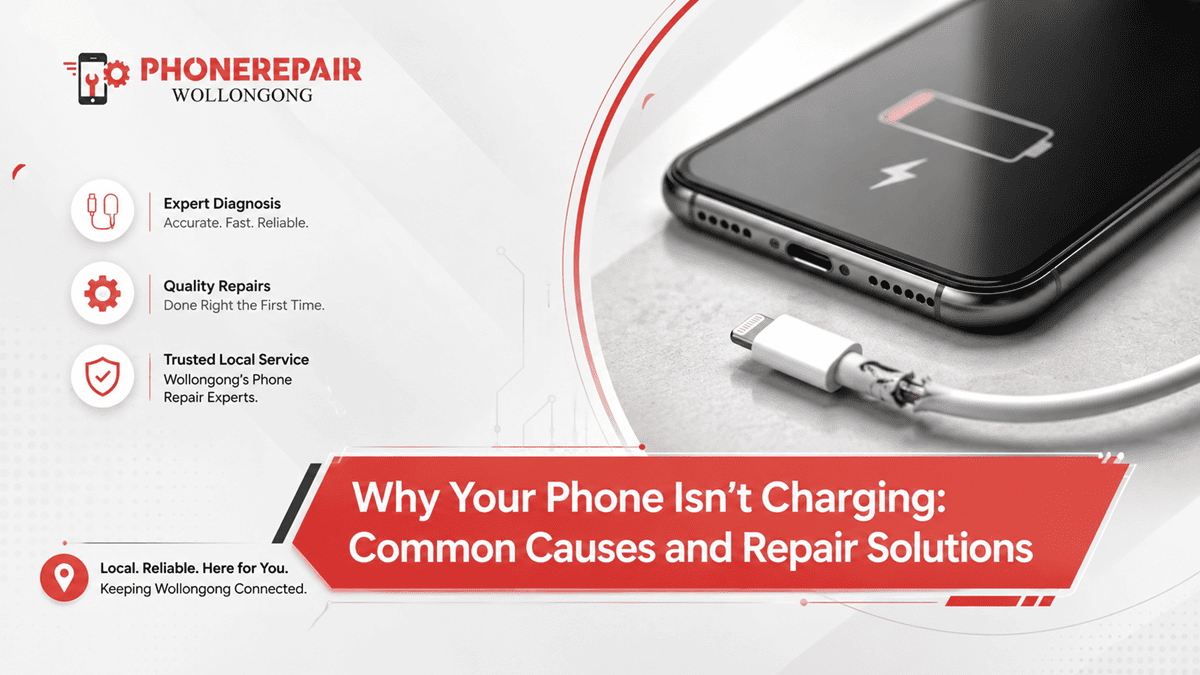
You plug the phone into your charger, see the familiar battery icon, but…nothing. You try again. Still nothing. There are, perhaps, no more annoying iPhone glitches than this and especially when that battery is already at two per cent.
A phone that doesn’t charge however, doesn’t mean the repair has to cost a lot. Other times, there is lint in the charging port. With some, however everything appears to be in order but the cable has failed internally. That being said, charging concerns can also lead to a damaged port, worn battery or motherboard fault.
Here at Phone Repairs Wollongong, we often see devices that are simply slow charging, intermittent or stop working altogether. This is a guide to help you identify the potential cause and determine whether you require a simple resolve or professional phone charging repair.
Common Signs of a Phone Charging Problem
If the charging connection is completely dead, it’s not hard to notice. But first, most faults begin from the minor signs.
Your phone may have a charging issue when:
- It only charges when you hold the cable at a certain angle.
- The battery percentage rises extremely slowly.
- Charging repeatedly starts and stops.
- The phone says “accessory not supported”.
- The charging plug feels loose inside the port.
- Wireless charging works, but cable charging does not.
- The device becomes unusually hot while connected.
- The battery percentage drops even while charging.
- Your computer no longer recognises the phone through USB.
These signs often get worse over time. Therefore, arranging an inspection early may prevent further damage to the port, battery or internal charging circuit. Get details on Android Repairs in Shellharbour.
Quick Charging Problem Comparison
Symptom | Likely cause | Possible solution |
No charging symbol | Faulty cable, adaptor or charging port | Test another charger and inspect the port |
Cable works at an angle | Loose or damaged port | Charging port repair or replacement |
Very slow charging | Weak adaptor, dirty port or ageing battery | Clean port, use suitable adaptor, test battery |
Phone gets hot | Damaged battery, unsuitable charger or software load | Disconnect charger and arrange inspection |
Charging stops randomly | Loose connection, moisture or cable damage | Dry device, replace cable or repair port |
Wireless charging only | Damaged USB or Lightning port | Professional port diagnosis |
Battery drains quickly | Worn battery or background activity | Battery health test and possible replacement |
1. Your Charging Cable Has Failed
A bad cable remains one of the most common reasons for a phone not responding to charging. The outside of the wire may look fine, but inside its confines tiny wires can break after being bent and twisted time after time again.
Now, this begins with confirming the phone using functional cable. Use preferably one that you know will work with another device. Also check for any fraying near the connectors, bent pins or dark marks around the plug.
Charging can also be unstable due to using cheap or not well made cables. As a result, the device may charge slowly, disconnect dozens of times or simply show an alert. A good, standard-compliant cable typically provides a more stable and safer connection.
2. The Wall Adaptor Is Faulty
Everybody blames the phone or cable except for the wall adapter. Yet, adaptors can malfunction following electrical surges, overheating or common wear as well.
Connect the same cable to some other adaptor or USB port on the computer. If the phone does start charging, then most likely, you will need to get the original adaptor replaced. Also, determine if the adaptor is sufficient to power your device.
A low-output adaptor will be able to charge an older phone, but may not cope with a newer model. Hence, the battery level may hardly budge in the middle of using for instance navigation, video or gaming apps.
3. Dust or Lint Is Blocking the Charging Port
Phones spend plenty of time inside pockets and handbags. Therefore, lint, sand and dust gradually collect inside the charging port. The material can become compacted at the back, preventing the plug from sitting properly.
A blocked port often makes the cable feel loose. You may also need to wiggle it before charging begins.
Turn off the phone before cleaning the port. Never jam the metal pen, key or liquid cleaners inside it. These can also short out or ruin the contacts. Instead use a soft dry brush gently. If the area appears to be well packed, a technician can extract the debris with appropriate equipment.
4. The Charging Port Is Damaged
The charging port can get damaged by repeatedly moving the cable, dropping it or plugging it in with force. Malfunction can be caused by bent contacts, cracked solder joints and wear inside (needless to mention).
Loose port often leads to nominal charging. That means the phone will charge on a desk but as soon as you pick it up, it will disconnect. Ultimately, it will give up the go before.
It could be a port replacement or soldering the port to the board in case of professional repair. The specific process elaborates on the phone model. However, repairing early on does help limit the damage from spreading to components that are adjacent.
5. Moisture Has Entered the Port
Recent phones earlier were wary of moisture like this. You should receive notifications when they sense water in the charge appliance. If your cellphone gets too wet, you might even see this message on a water resistant model after passing through rain, humidity, sweat or condensation.
Do this as soon as you receive a warning or unplug. Next, power down the phone and let the dock drip dry naturally in a well-ventilated area. And over lots of heat individuals ought to steer clear of hairdryers, heaters as well as bright sunlight simply because the unnecessary heat can certainly destroy battery packs and even seals.
And please don’t also put the phone into rice. Rice dust can get inside the ports and grain does very little to combat moisture. If this warning persists after drying, schedule a mobile phone repair in Wollongong to have the device checked properly. Looking for a Android Repairs in Dapto?
6. The Battery Has Reached the End of Its Useful Life
Rechargeable batteries have a limited lifespan. This means that an older battery may be slower to charge, less durable or even shut down before blanking out completely.
Other alerts are sudden shutdowns, batteries inflating and also a phone that gets warm on normal usage. Inflated batteries require urgent intervention because they can push the screen on one side or damage internal elements.
They contact us to check the battery; a technician examines the battery health and also fixes whether replacing a phone battery will help or not. Often a timely battery replacement repairs dependable charging for everyday service.
7. Software Is Interrupting the Charging Process
Not all of them are due to broken hardware. Sometimes the software crashes and your phone does not recognise the charger.
Cut off power and reconnect the cable To install available operating-system updates, next. Aside from this, you might want to kill apps that use a lot of power, and see if your phone charges faster when it’s turned off.
But persistent charging failures following a reboot are typically indicative of a hardware issue. By then, more professional testing is a better answer than keep resetting this device. Get details on Android Repairs in Warrawong.
8. The Phone Is Too Hot or Too Cold
Smartphones can suspend charging when they detect that the internal temperature is above or is below a safe point. This protects the battery from harm.
Perhaps you left your phone in a hot car, therefore it is not charged. Just as extreme heat can bring that down, orders of magnitude extreme cold also does for batteries. Ensure to transfer the device into a room temp and give it some time before connecting it again.
Disconnect the device and arrange an inspection if the telephone heats up every time you charge it. Continuous heat might mean a damaged battery, failing charging component or incompatible adaptor.
9. The Internal Charging Circuit Has Failed
Sometimes, the cable, adaptor, port and battery all work correctly, yet the phone still will not charge. In that situation, the problem may involve the charging controller or another motherboard component.
Board-level faults can develop after liquid damage, electrical surges or impact. Therefore, technicians need diagnostic equipment to test power flow and locate the failed component.
These repairs require specialist skills. Attempting a DIY board repair can make the damage worse and may reduce the chance of recovering important data.
Related Services:
» Android Repairs in Unanderra
» iPhone Repairs in Shellharbour
» iPhone Repairs in Albion Park
Safe Checks You Can Try at Home
Before booking a repair, try these basic steps:
- Restart the phone.
- Test a different compatible cable.
- Try another wall adaptor and power socket.
- Remove the case and reconnect the charger.
- Check the port under good lighting.
- Allow the phone to cool if it feels hot.
- Install available software updates.
- Test wireless charging if the model supports it.
If you smell burning, see any swelling, smoke or excessive heat, stop testing. For those cases, turn it off and clear of anything flammable until a technician can take a look at it.
Related Articles:
» Warning Signs Your Android Phone Needs Immediate Repair
» Expert Phone Battery Replacement Services in Wollongong
» Expert OPPO Water Damage Repair Services: What You Need to Know?
» Expert iPhone Repair Services for Broken Screens
» Professional iPhone Water Damage Repair: What You Should Know?
When Should You Book a Professional Repair?
Book a charging port repair if the phone cable is loose, only works in a certain position or keeps disconnecting. Likewise, ask for repair when the phone reveals signals of being wet, overheating or battery swelling.
The repair engineer will check the charging add-ons, port, battery and inner electrical energy components. This way, you circumvent replacing components on speculation.
Phone Repairs Wollongong provides device diagnosis for charging issues of popular smartphone devices including iPhones, Samsung Galaxy, Google Pixel and other smartphones. When the fault is traced, we will have alternatives to repair and then proceed.